
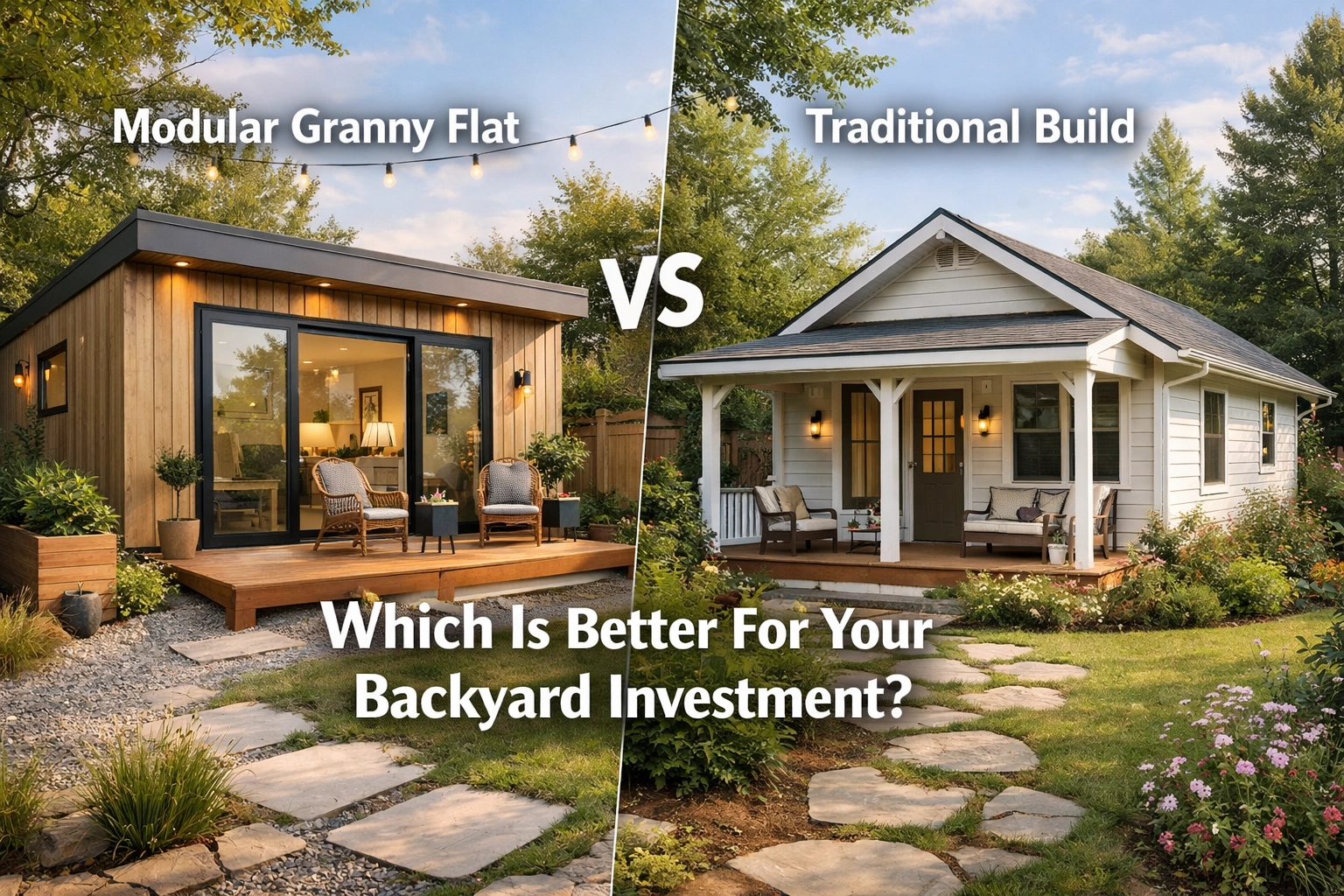
You've got that patch of backyard sitting there. You've crunched the rental yield numbers. You've scrolled through council regulations at 11pm. Now you're stuck on the biggest question: do you build a granny flat the traditional way, or go modular?
Here's the short answer: if you're treating this as an investment: not a passion project: modular wins on almost every metric that matters. Speed, cost certainty, quality control, and time to first rent cheque all favour factory-built construction.
But let's break down exactly why, because this decision will shape your ROI for the next decade.
Speed: Weeks vs Months of Disruption
Traditional site-built granny flats take anywhere from 6–12 months from slab pour to final inspection. That's nearly a year of tradies in your backyard, weather delays pushing timelines, and neighbours giving you the side-eye over noise and trucks blocking the street.
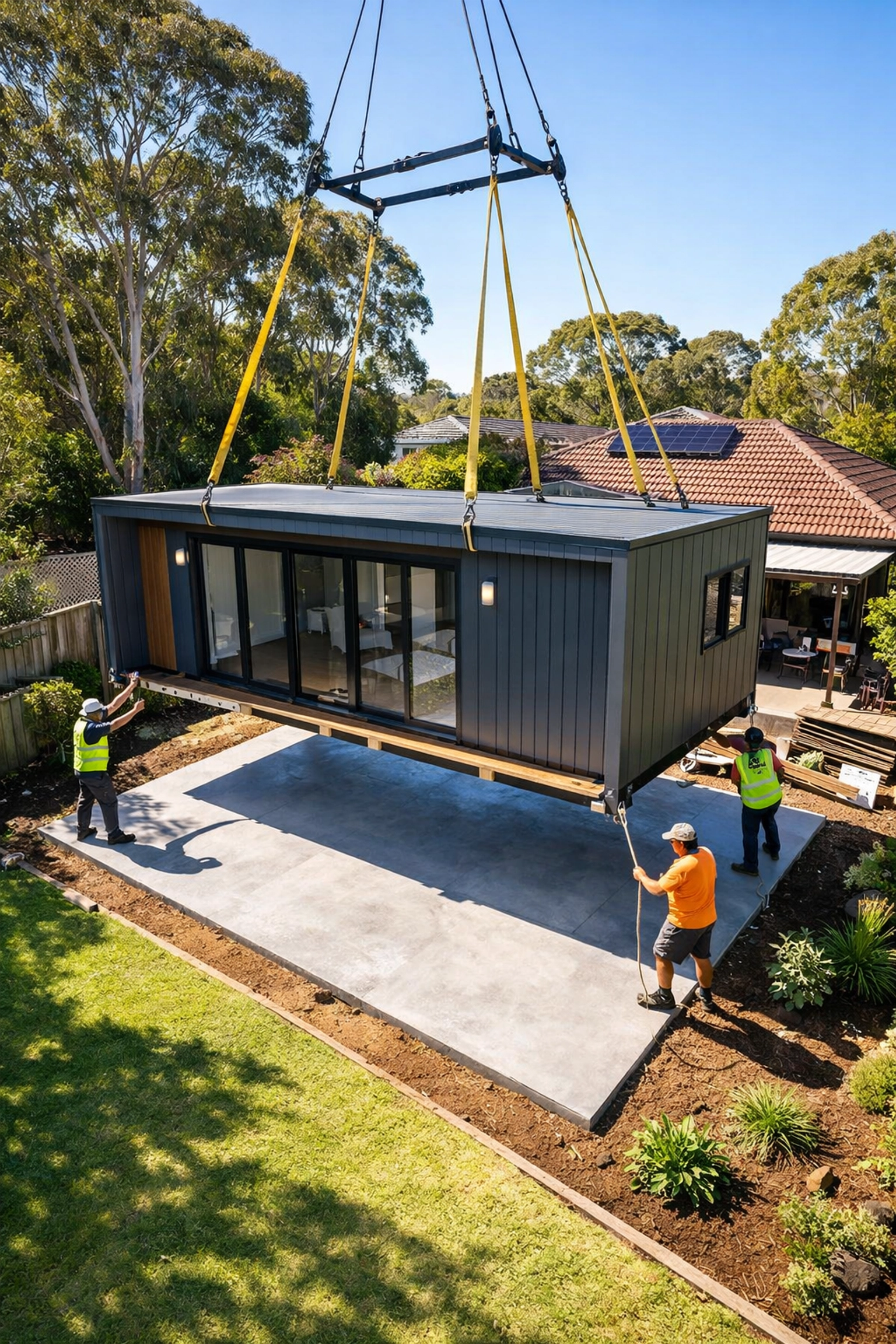
Modular granny flats flip that script entirely. The bulk of construction happens in a factory while your site prep happens simultaneously. Once the modules arrive, installation takes 1–3 days. Total timeline? 12–16 weeks from deposit to certificate of occupancy.

That time difference isn't just about convenience: it's about rental income. Every month your granny flat sits unfinished is a month you're not collecting rent. At $450–$500/week in most Australian metros, delays cost you real money.
And here's what the traditional builders won't tell you: site-built projects are notorious for blowouts. Bad weather, subcontractor availability, materials stuck in supply chains: all of it extends your timeline. Modular builds happen indoors where rain, heat, and scheduling chaos can't touch them.
Cost Certainty: Fixed Price vs Hidden Extras
Ask anyone who's done a traditional build about budget, and you'll hear horror stories. "Just another $8K for waterproofing we didn't account for." "Council wants another inspection: that'll be $1,200." "Timber prices went up, so we need to revise the quote."
Traditional granny flats in Australia typically run $110,000–$130,000, but that's the starting figure. Cost overruns average 15–20% because site conditions are unpredictable and pricing is fragmented across multiple contractors.
Modular construction operates differently. Factory pricing is fixed. Your quote includes the structure, transport, installation, and connections. No surprises, no variations, no "we found rock when we excavated" moments that blow your budget.
Most modular granny flats land in the $100,000–$110,000 range, fully installed and council-ready. That's not just cheaper: it's predictable, which matters enormously when you're borrowing to fund the build or managing cash flow.
The financial risk profile changes completely. With modular, you know your total investment from day one. With traditional builds, you're managing multiple contracts, progress payments, and the constant possibility that something unexpected will cost you thousands.
Quality: Precision Engineering vs Exposure to Elements
There's a persistent myth that site-built equals better quality. It's outdated.
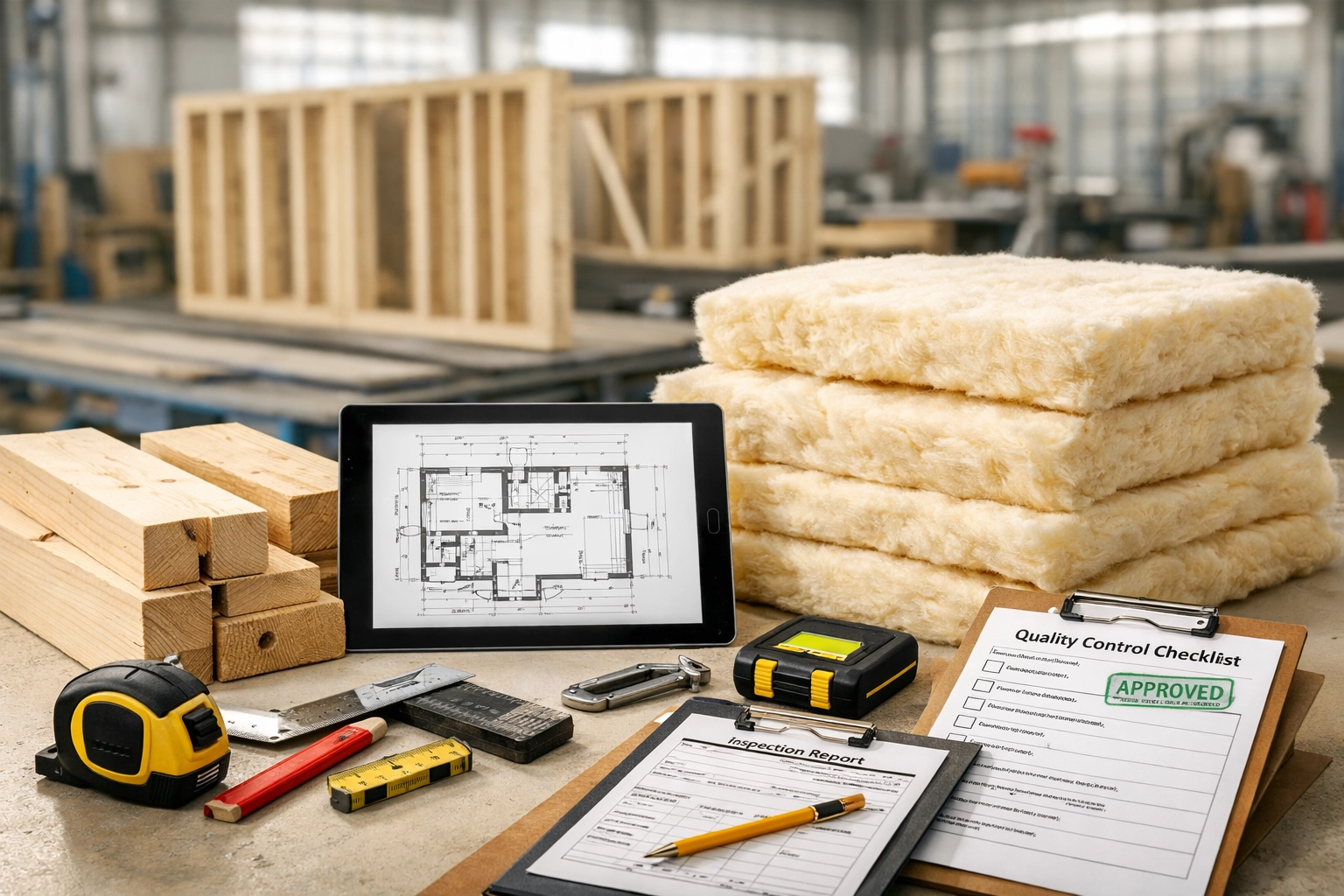
Modular granny flats are engineered in controlled factory environments using jigs, templates, and quality checkpoints at every stage. Each wall, roof truss, and electrical rough-in is built to millimetre precision before it leaves the facility.
Compare that to site construction: timber framing exposed to rain before the roof goes on, tradespeople working in 38-degree heat or freezing mornings, mud tracked through finished areas. The conditions alone introduce variables that affect long-term durability.
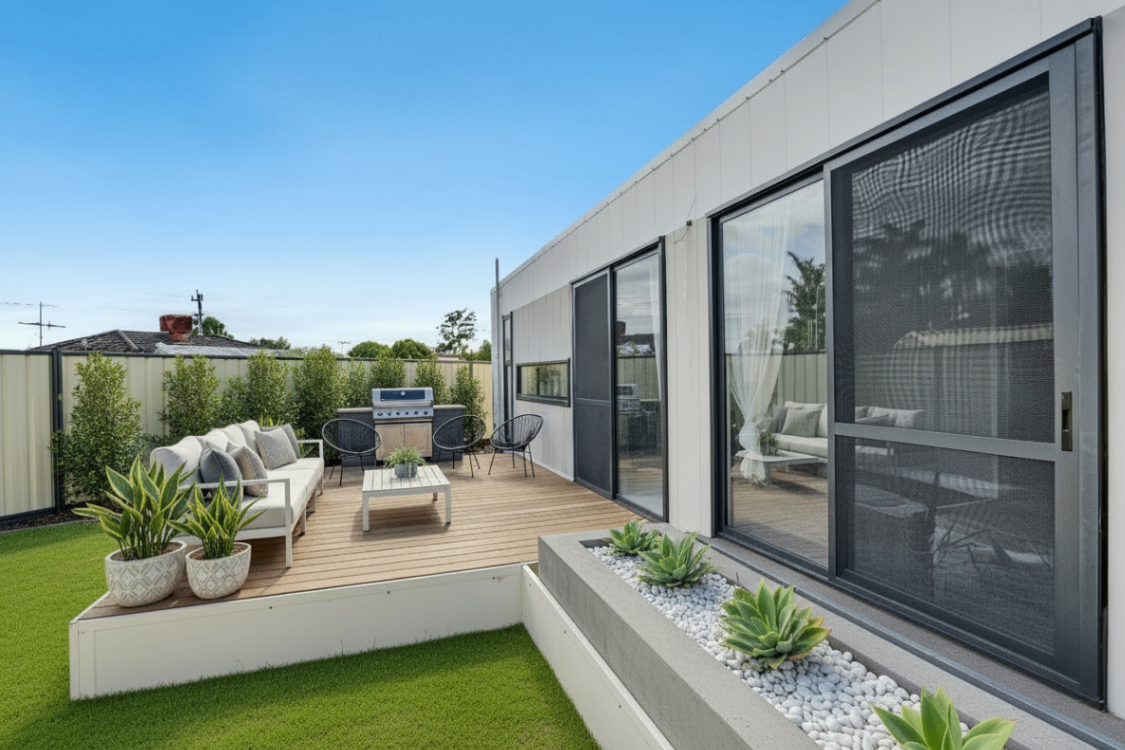
Factory construction also means better insulation performance. Walls and ceilings are sealed in controlled conditions, not screwed together on-site where gaps and thermal bridges sneak in. For modular homes in Australia, this translates to lower energy bills and more comfortable living spaces: critical if you're marketing your granny flat to quality tenants.
And here's the thing about quality you won't see in brochures: consistency. Every modular unit that rolls out of a factory meets the same standard because the process doesn't change. Site builds depend entirely on which subcontractors your builder managed to book that month.
Rental Income: The Faster It's Up, The Faster You Profit
Let's talk ROI in concrete terms.
A modular granny flat that costs $105,000 and rents for $470/week (typical for a well-located Brisbane property) will break even in roughly 4.3 years. That same property built traditionally at $125,000 extends your payback to 5.4 years: assuming no cost overruns.
But the real advantage isn't just total cost. It's time to first rent.
If your modular build completes in 14 weeks, you're collecting rent by month four. A traditional build taking 9 months means you don't see income until month ten. That's six months of lost rent: approximately $12,000 you'll never recover.
For investors running the numbers, this changes everything. Faster completion means faster cash flow, which improves your debt serviceability and lets you move on to the next investment sooner. Modular construction compresses the timeline between capital outlay and income generation in a way traditional builds simply can't match.
And if you're leveraging our EcoHub Finance Pathway, that speed advantage compounds. Lenders love modular projects because the risk profile is lower: fixed costs, faster completion, proven rental demand. That can translate to better rates and terms.
Sustainability: Less Waste, Better Performance
Traditional construction is wasteful. Skip bins overflow with offcuts, packaging, and materials ordered in excess "just in case." Estimates suggest site-built projects generate 20–30% more waste than factory construction.
Modular manufacturing operates on lean principles. Materials are purchased in bulk, cut precisely by CNC machinery, and excess is captured and reused across multiple projects. The result? Significantly less landfill and lower embodied carbon.
Energy performance is also superior. Factory-built granny flats typically achieve higher insulation ratings because thermal bridging is minimised and sealing is consistent. For a rental property, this means lower utility bills: a genuine selling point when you're advertising the space.
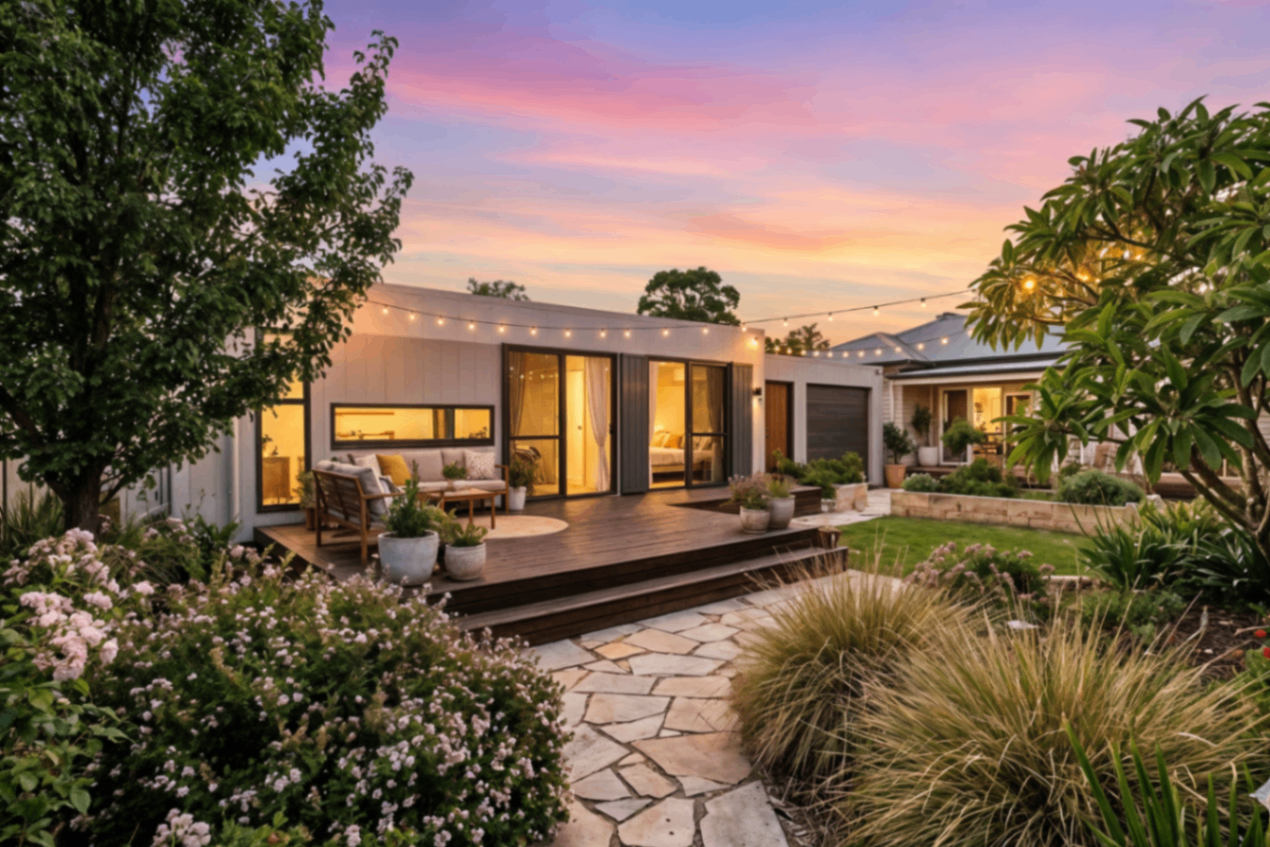
Sustainable construction isn't just good marketing. Tenants increasingly care about energy costs and environmental impact. A well-insulated modular granny flat that stays cool in summer and warm in winter will attract higher-quality tenants willing to pay a premium.
And if you're future-proofing the investment, modular homes in Australia are increasingly designed for solar integration, battery storage, and off-grid capability: features that traditional builds often retrofit awkwardly after the fact.
When Traditional Builds Might Make Sense
Modular isn't the answer for every scenario. If you're after complete architectural integration with your existing home: matching brickwork, custom rooflines, heritage details: traditional construction offers unlimited customization.
Sites with narrow access, extreme slopes, or unusual council restrictions may also favour traditional builds where flexibility matters more than speed. And if you're planning to live in the granny flat yourself long-term rather than rent it, the investment calculus shifts toward personal preference over ROI.
But for pure backyard investment: where speed, certainty, and rental return are the priorities: modular construction delivers a better outcome in almost every measurable way.
The Verdict: Modular Wins For Investment
If you're building a granny flat to generate passive income, the case for modular is overwhelming. You'll save time, lock in costs, ensure quality, and start collecting rent months earlier. Traditional builds offer flexibility and customisation, but they come with longer timelines, unpredictable budgets, and greater execution risk.
For landlords and property investors, modular simply makes more financial sense. The faster you complete construction, the faster you start earning. It's that straightforward.
Want to explore what a modular granny flat could look like on your property? Start with our modular home models and floor plans or run the numbers using our modular home cost guide. If you want a clear answer on what’s possible on your block—access, approvals, timelines, and pricing—get in touch with EcoHub Homes and we’ll map out the fastest, cleanest path to “ready to rent”.