
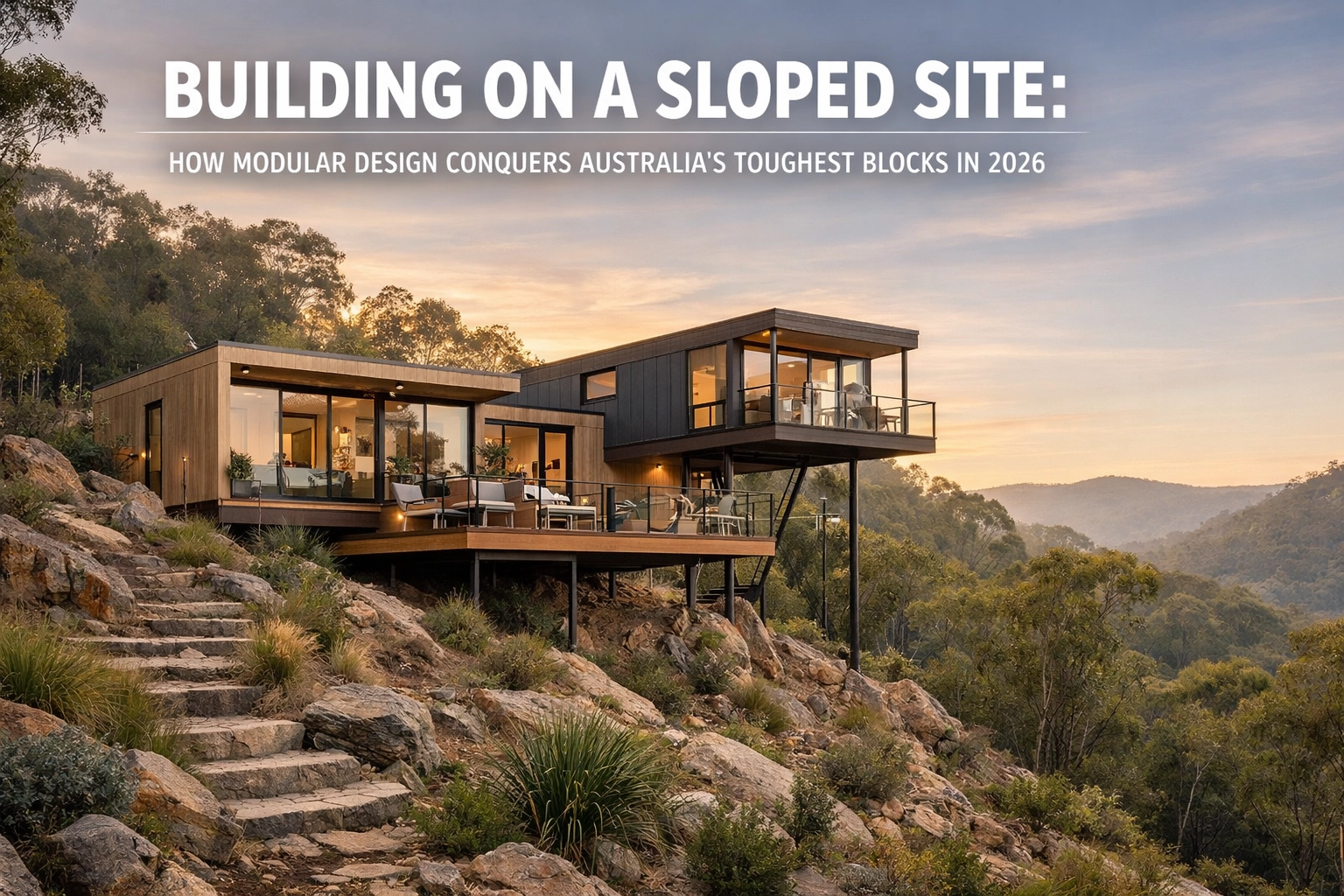
If you’ve been hunting for vacant land in Australia lately, you’ve probably noticed a pattern. The flat, "easy" blocks are either eye-wateringly expensive or gone before the "For Sale" sign even hits the grass. What’s left? The "impossible" blocks: the ones with steep inclines, sweeping views, and a price tag that actually looks reasonable.
For years, traditional builders have looked at these sloping sites and seen nothing but dollar signs and headaches. Massive excavation, retaining walls that cost as much as a luxury car, and months of site "scarring" before a single brick is laid.
But it’s 2026, and the game has changed. At EcoHub Homes, we’re seeing a massive surge in people asking: "Can I build on a sloping block with modular homes in Australia?"
The answer is a resounding yes. In fact, modular design isn't just a workaround for sloped land; it’s the superior way to build on it. Let’s dive into how precision engineering is turning Australia’s toughest terrain into some of its most stunning homes.
The Reality of the Slope: Why Modular Wins in 2026
Building on a slope usually brings a 20% to 40% cost increase compared to a flat block. There’s no sugar-coating that. Whether you’re building traditional or modular, gravity still exists, and foundations on a hill require more engineering.
However, the difference lies in how those costs are allocated. With a traditional build, a huge chunk of your budget disappears into the ground, literally. You pay for massive excavation, tonnes of soil removal, and complex drainage systems.
With an EcoHub Homes modular build, we skip the "big dig." By using precision-engineered foundation systems, we keep the house above the land rather than forcing the land to change for the house. You aren’t paying to fight nature; you’re paying for the technology to live within it.
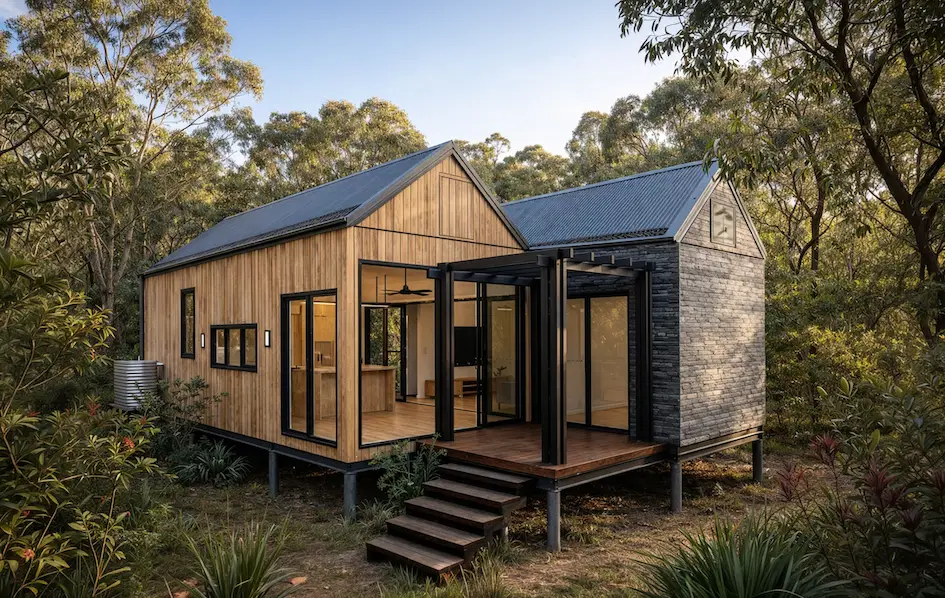
Precision Engineering vs. The "Cut and Fill" Nightmare
The traditional way to handle a slope is "cut and fill." You cut a flat shelf into the hill and fill the lower side with the dirt you removed. It’s messy, it’s expensive, and it creates massive environmental disturbance.
In 2026, we lean into precision engineering.
Adjustable Steel Piers
The secret weapon for sloping sites is the adjustable steel pier system. Instead of pouring a massive concrete slab, we use high-strength steel columns. These piers are drilled into the stable ground, and because they are adjustable, we can level the house perfectly regardless of how much the ground drops away underneath.
This approach offers several massive wins:
- Reduced Excavation Costs: You save thousands by not needing heavy machinery to reshape the entire block.
- Natural Drainage: By keeping the home elevated, the natural water runoff of the hill isn't blocked. This prevents the dampness and drainage issues that often plague traditional homes on hills.
- Speed: While a traditional builder is still waiting for their concrete slab to cure or their retaining walls to be signed off, our modules are already being finished in the factory.
The 2026 Aesthetic: Maximizing Views and Natural Light
One of the best things about building on a sloped site is the view. Why buy a block with a 20-degree incline if you aren't going to look at the horizon?
Our 2026 design philosophy at EcoHub Homes focuses on "Touch the Earth Lightly." Because the homes are elevated on piers, we can position them higher on the site than a traditional home might allow. This often means you get views that your neighbours: stuck in their "cut and fill" bunkers: completely miss out on.
We utilize full-height, double-glazed windows and open-plan layouts (like our 3-bedroom T-House) to flood the home with natural light. When your home is elevated, you aren't just looking at the fence; you're looking over the treetops.
Turning "Difficult" Land into Passive Income
Here is the EcoHub Homes USP that savvy investors are jumping on in 2026: The Passive Income Pivot.
There are thousands of "unbuildable" vacant blocks sitting in Australian suburbs and regional towns. Because traditional builders have quoted $100k+ just for the site works, these blocks sit empty.
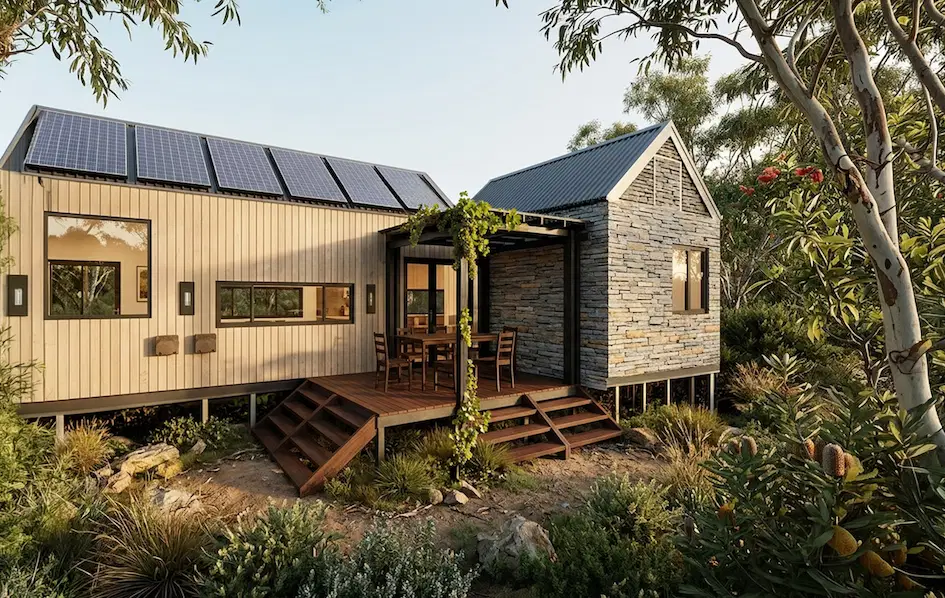
As a land owner, this is your opportunity. By choosing a modular approach, you can unlock the value of a "cheap" sloping block. What others see as a liability, you can turn into a high-yield rental property or a stunning AirBnb retreat.
Our one-bedroom modular homes are particularly popular for this. They have a small footprint, meaning even less site disturbance, and can be installed in a fraction of the time it takes to build a standard granny flat. Check out our modular homes cost guide to see how the numbers stack up for your specific site.
Essential Pre-Construction: Don't Skip the Homework
While modular design makes building on a slope easier, it doesn't make it magic. You still need to do the right prep work. In 2026, the technology for site assessment has never been better.
- Geotechnical Assessment (Soil Test): This is non-negotiable. We need to know what’s under the surface. Is it reactive clay? Solid rock? This determines exactly what type of pier system we use.
- Topographical Survey: This gives us a 3D map of your block. We use this to "virtually" place the home on the site to ensure the floor levels and entry points work perfectly with the terrain.
- Bushfire (BAL) Compliance: Many sloping sites are in beautiful, leafy areas. In 2026, building to high Bushfire Attack Levels (BAL) is a standard part of our process. Our steel-framed modules are designed to be resilient in Australia's toughest environments.
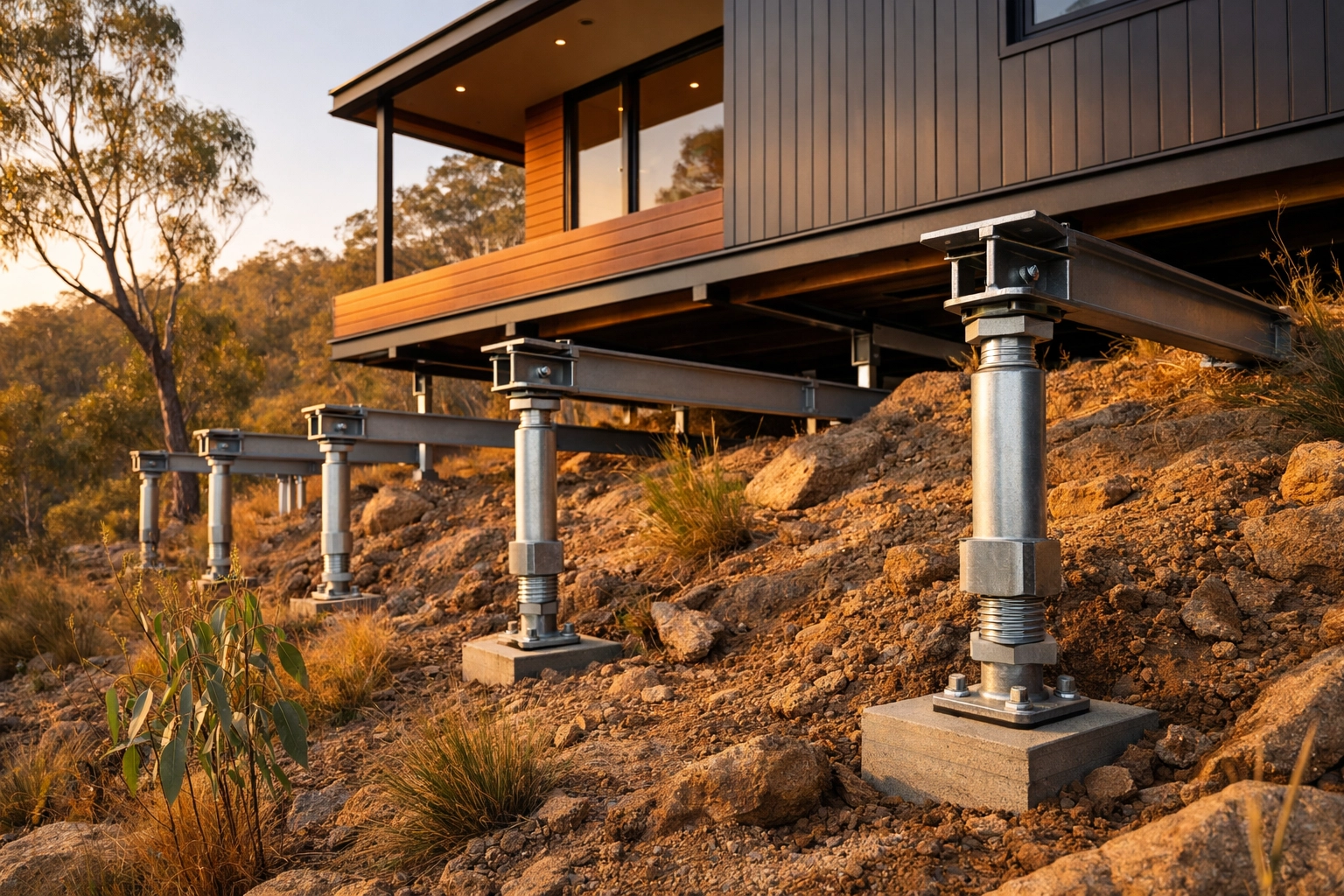
The Cost Breakdown: Modular vs. Traditional on a Slope
Let’s talk numbers. If you have a block with a 2-metre fall across the building envelope, a traditional builder might quote you an extra $50,000 to $70,000 just to get the site level and ready for a slab.
With a modular approach from EcoHub Homes, your foundation costs might increase by only $25,000 to $35,000 for the additional steel pier heights and specialized crane hire.
Why the difference?
- No Retaining Walls: In many cases, an elevated modular home removes the need for expensive retaining walls entirely.
- Simultaneous Progress: While your piers are being installed on-site, your house is being built in the factory. You aren't paying interest on a construction loan for 18 months while a builder struggles with mud and rain on a steep driveway.
We typically see occupancy happen within 5 to 9 months for modular builds on sloped land, compared to 15 to 20 months for traditional "pole homes" or complex hillside builds.
Environmental Stewardship
In 2026, we can't ignore the footprint we leave behind. Traditional hillside construction is "extractive": it takes away from the land. Modular construction is "additive." We bring a finished, high-efficiency product and place it gently onto the site.
By avoiding massive excavation, we preserve the root systems of nearby trees and keep the natural topsoil intact. This means your landscaping looks established much faster because the ground hasn't been turned into a moonscape during the build.
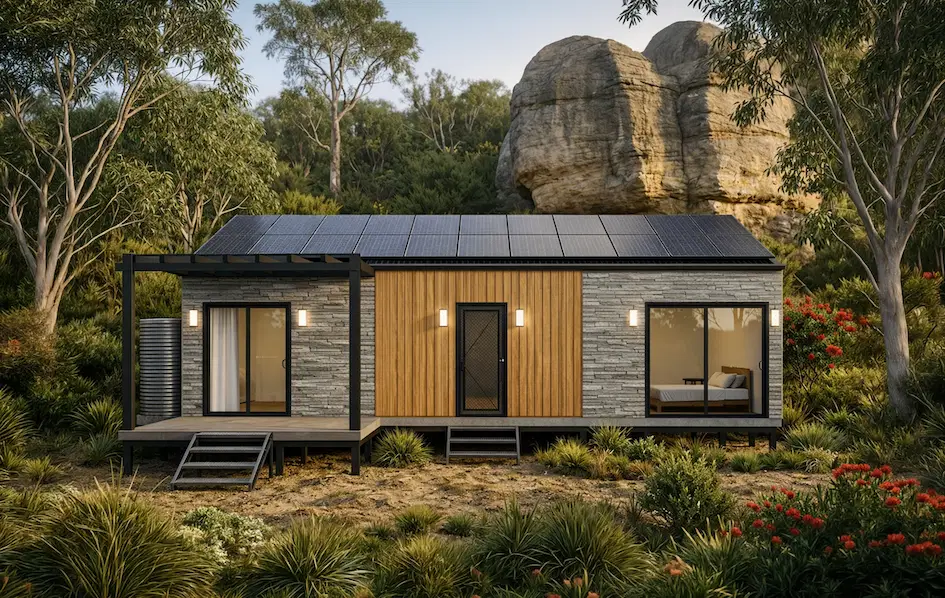
Is Your Block Ready for a Modular Transformation?
Building on a sloped site used to be a dream reserved for those with bottomless pockets. In 2026, thanks to the precision of modular construction and the expertise of the team at EcoHub Homes, those "impossible" blocks are now incredible opportunities.
Whether you're looking for a three-bedroom family home that captures the valley views or a high-spec 10-star energy-rated masterpiece, we have the engineering to make it happen.
Don't let a hill stand in the way of your dream home. Let's look at the contours together and figure out how to make that slope work for you, not against you.
Ready to see what's possible?
Book a free consultation with our team today, and let’s turn that challenging block into your new reality.