
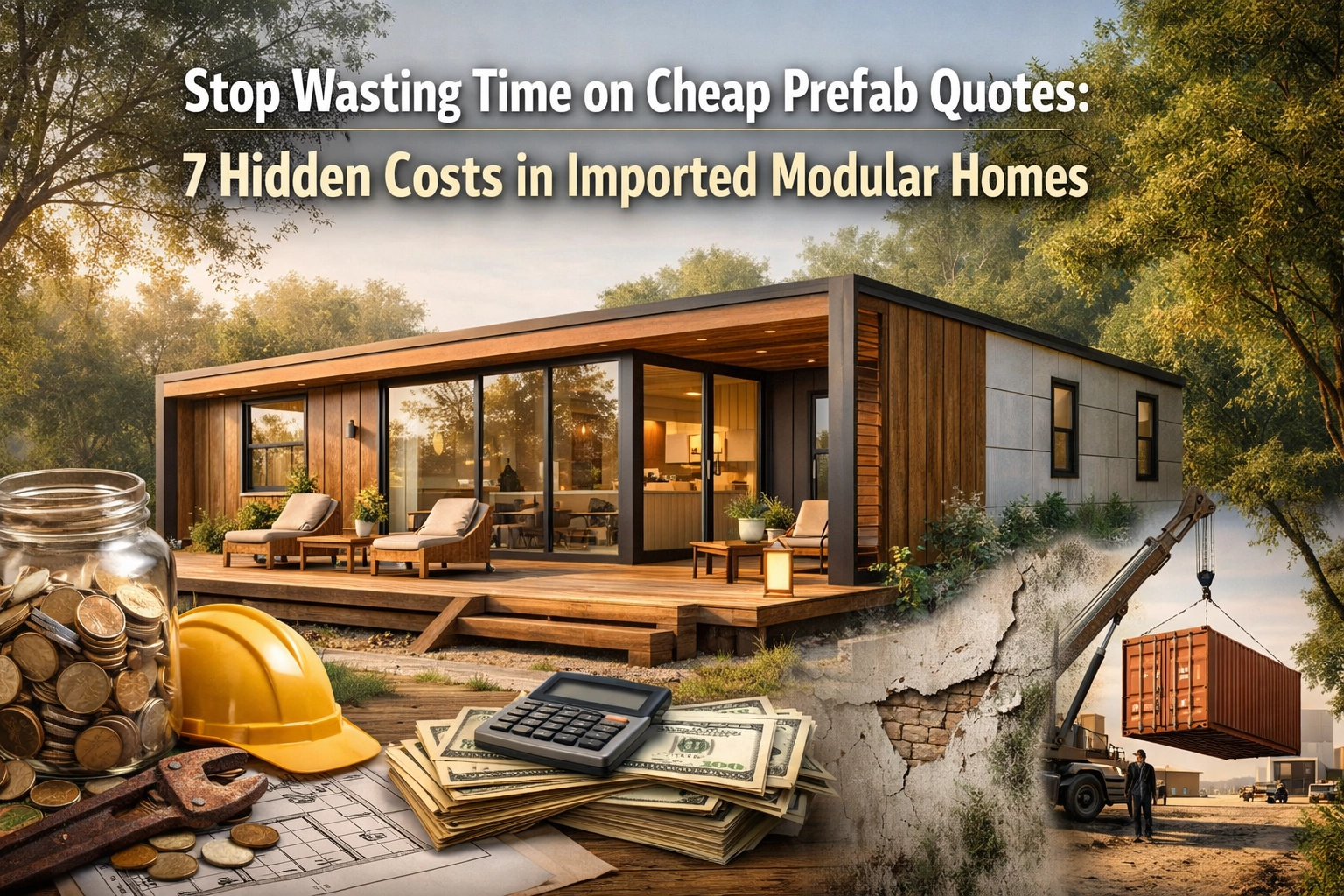
You've seen the ads. "$89,000 for a complete 3-bedroom modular home!" Scroll through Instagram and Facebook: they're everywhere. Imported prefab homes promising luxury finishes at prices that make traditional builders weep.
Here's what those ads don't tell you: that $89,000 is just the beginning. By the time your imported modular home is actually liveable, you're looking at an additional 30–40% on top of that factory price. Sometimes more.
Let's break down the seven hidden costs that turn those too-good-to-be-true prefab house prices into budget nightmares: and why understanding modular home prices from Australian manufacturers like EcoHub Homes saves you money, stress, and months of delays.
1. Site Preparation: The $10,000–$100,000 Surprise
Your land isn't flat. It's never flat. Even that "perfectly level" block you bought sight unseen needs work before any modular home touches down.
Site preparation includes drainage correction, retaining walls, stem walls, and elevation adjustments. Rocky soil? Add excavation costs. Sloping block? You're looking at significant earthworks. The range is enormous: $10,000 for simple jobs on cooperative land, upwards of $100,000 for challenging sites.

Imported prefab homes rarely include site assessments in their quotes. You're flying blind until a local contractor tells you what the land actually needs. With EcoHub Homes, site preparation consultation comes standard. We assess your block before quoting, so there are no nasty surprises three weeks before delivery.
2. Compliance and Certification Costs Nobody Mentions
Here's where imported modular homes get expensive fast. That beautiful container home from overseas? It wasn't built to Australian standards. NCC 2025 compliance isn't optional: it's the law.
You'll need:
- Engineering certifications for Australian conditions (cyclone ratings, bushfire zones, thermal performance)
- Modifications to meet energy efficiency requirements
- Structural reports from Australian-certified engineers
- Compliance documentation for every trade
Each certification costs money. Each modification delays your build. Many buyers discover their imported unit needs thousands in retrofitting just to pass council inspections.
Australian-manufactured prefab homes Australia come pre-certified. EcoHub Homes builds to NCC 2025 from the ground up. No retrofits, no compliance scrambling, no council rejection letters.
3. The Permit and Inspection Marathon
Every municipality requires permits. Every trade needs inspection. Structural. Electrical. Plumbing. Mechanical. Gas. Septic (if applicable). The list goes on.
Budget $1,000 to $5,000 minimum: more for complex homes or difficult councils. Processing times vary wildly. Some councils fast-track modular applications. Others treat them like Martian landing pods requiring six-month approval processes.
Imported homes face additional scrutiny. Councils want proof of compliance. They want Australian engineering stamps. They want documentation that overseas manufacturers rarely provide in formats Australian authorities accept.
Local manufacturers navigate council relationships daily. We know which documentation satisfies which councils. We've done this hundreds of times. You benefit from that experience.
4. Foundation Work: No Home Without One
Your modular home needs something to sit on. Slab? Crawl space? Full basement? Each option carries different costs depending on soil conditions, local codes, and home specifications.
Imported units often specify foundation requirements that don't match Australian conditions. The specs might be metric conversions from imperial measurements. Load calculations might not account for Australian wind ratings. You're paying a local engineer to recalculate everything, then paying a concreter to build something that actually works.
Australian manufacturers design foundations for Australian conditions from day one. Our homes include foundation specifications that local concreters understand and councils approve without drama.
5. Delivery and Assembly: The $15,000–$70,000 Reality Check
That imported modular home needs to get from a shipping container to your block. Then it needs assembly by qualified tradespeople who probably haven't seen this particular brand before.
Crane and rigging services: $2,000–$10,000 per day. Module integration and finishing: variable, but substantial. Electrical and plumbing connections: charged by the hour while contractors puzzle through unfamiliar systems.
Total assembly costs often hit $15,000 to $70,000 depending on home complexity and how "helpful" the imported manufacturer's instructions are. Spoiler: they're rarely helpful.

Local manufacturers include delivery within reasonable distances. We coordinate with contractors who've installed our homes dozens of times. They know the systems. They know the connections. Assembly happens faster and costs less because everyone's speaking the same language.
6. Utility Hookups: Distance Isn't Free
Connecting to water, sewer, electricity, gas, and internet costs money. The further from existing infrastructure, the more expensive it gets.
Rural blocks often require septic systems ($10,000–$30,000), water tanks, and extended electrical runs from the nearest pole. Even urban infill sites sometimes need service upgrades to handle a new dwelling.
Imported modular home companies have no idea what your local utility situation looks like. Australian manufacturers work with local conditions daily. We factor realistic utility costs into project discussions from the beginning.
7. Material Cost Fluctuations and Currency Risk
Imported homes lock in prices based on overseas material costs and exchange rates at the time of quoting. Between quote and delivery: often six to nine months: both can change dramatically.
Your $89,000 quote becomes $102,000 because the Australian dollar weakened and Chinese steel prices spiked. The contract probably includes clauses allowing price adjustments for material fluctuations. You're accepting currency risk without realising it.
Australian manufacturers quote in Australian dollars using Australian materials. What you're quoted is what you pay. No exchange rate gambling required.
The Local Advantage: What EcoHub Homes Actually Includes
When you compare modular home prices honestly: apples to apples, including all the hidden costs: Australian-made prefab homes Australia close the price gap significantly. Often they're cheaper all-in than imported alternatives.
Here's what working with EcoHub Homes looks like:
Transparency from day one. Site assessment before quoting. Realistic delivery timelines. Clear documentation of what's included and what's extra.
NCC 2025 compliance built in. No retrofits. No compliance surprises. No failed inspections requiring expensive modifications.
Council-tested documentation. We provide what councils want in formats they accept. Approval processes move faster.
Coordinated installation. We connect you with contractors who know our systems. Assembly times are shorter. Costs are predictable.
After-installation support. When something needs adjustment, we're a phone call away: not on another continent.

Making Smart Prefab House Price Comparisons
Budget-conscious buyers and investors need to compare total delivered cost, not advertised base prices. Here's your checklist:
- Base unit cost
- Delivery to site
- Foundation work
- Site preparation
- Utility connections
- Permits and inspections
- Assembly and integration
- Finishing work not included in base price
- Compliance certifications
- Currency and material price risk
Add it all up. That $89,000 imported unit might cost $140,000 installed and compliant. That $135,000 Australian-manufactured home might cost $155,000 fully delivered: but with certainty, speed, and support.
The Investment Perspective
Investors especially need to factor in opportunity cost. Every month your project is delayed: waiting for compliance approvals, sorting out foundation mismatches, coordinating contractors unfamiliar with your imported unit: is rent you're not collecting.
A three-month delay on a property that would generate $450/week costs you $5,400 in lost income. Six months? Nearly $12,000. Australian manufacturers get you to rental income faster. That speed has dollar value.
Your Next Step
Stop chasing low headline prices that mask expensive realities. Start comparing total delivered costs using the checklist above.
Want to see what transparent modular home prices actually look like? Explore our range: from efficient 1-bedroom units perfect for granny flats, to spacious 3-bedroom homes ideal for families or premium rentals.
We'll give you a complete picture upfront. No hidden costs. No compliance surprises. No currency gambling. Just honest pricing for quality Australian-made homes that meet Australian standards from day one.
Get in touch with EcoHub Homes for a straight-talking conversation about what your project actually costs: and how quickly we can have you earning rental income or living in your new space.